By Nikki Johnson, Regional Economist
The Hampton Roads PDC/TPO recently claimed the top prize at the Hampton Roads 2024 Datathon, an annual competition that brings teams from across the region to tackle regional issues through data-driven solutions. This year’s theme centered on infrastructure, inspiring our team to investigate the role of trees as a green infrastructure solution to mitigating Urban Heat Islands (UHIs) at bus stops in Hampton Roads.
UHIs occur in metro areas where dense, built-up environments absorb and retain heat, leading to much higher temperatures than nearby areas. Bus stops located in a UHI can expose waiting passengers to intense sunlight, which can lead to discomfort, heat stress, and even heat-related illnesses. A potential green infrastructure solution, tree canopies offer natural shade that reduce surface temperatures. Research also indicates that tree canopies outperform traditional bus shelters, which, depending on their design, may provide only half the cooling effect of natural shade from trees. For this project, we analyzed tree canopy coverage and UHI severity data to identify which bus stops could be prioritized in a theoretical urban tree planting project.
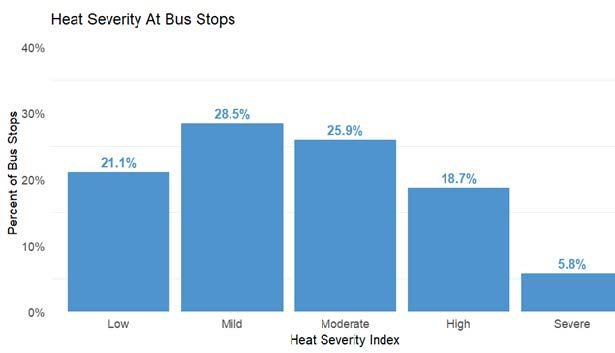
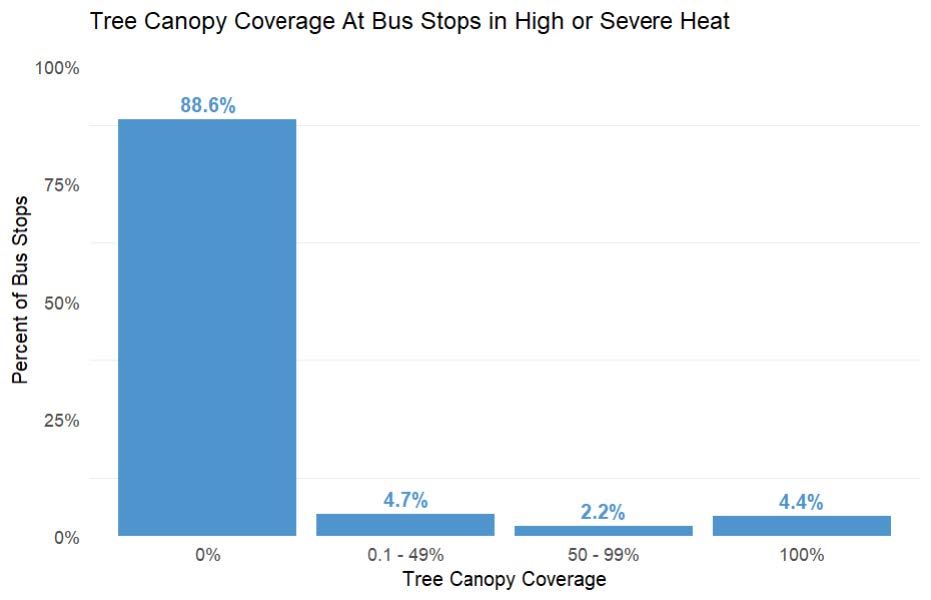
Using land cover data from the Chesapeake Bay Foundation, we estimated the percentage of tree canopy coverage around each bus stop by analyzing the land cover in a 5-foot radius around each stop. Our analysis found that of the approximately 3,200 bus stops in Hampton Roads, nearly 85% of bus stops have zero canopy coverage, while 7% are completely covered by tree canopy. We then utilized data from the Trust of Public Land to identify the level of heat severity around each bus stop, finding more than one in four are in high or severe UHI areas. Combining this with the tree canopy coverage estimates, we found a slightly higher share of bus stops in high or severe UHI areas (89%) have zero canopy coverage compared to all bus stops (85%). In a theoretical urban tree planting project, we identified 132 bus stops located in severe Urban Heat Islands (UHIs) with no existing tree canopy coverage, making them high-priority sites for intervention.
 |  |
| Data sources: Chesapeake Bay Foundation, Trust of Public Land, ESRI, HRPDC. |
However, recognizing that data alone cannot fully capture on-the-ground realities, we designed a survey to demonstrate how crowdsourcing can complement data analysis. The survey asks passengers a few simple questions about its condition, availability of shade, and preferences for shade-improving designs. If implemented, the survey results could provide valuable community insights to validate and refine the initial analysis, ensuring that shade interventions are directed at the stops most in need.
Our research highlights the how data, when thoughtfully integrated and complemented by community voices, can be an invaluable tool for addressing local issue; a critical part of the work we do at the Hampton Roads PDC/TPO.
Read the rest by downloading the PDF.